My Cart

 All Category


The violence of 1948 in Maharashtra is not widely remembered today. In the aftermath of Gandhi’s assassination, Brahmin families—teachers, priests, farmers, professionals—suddenly found themselves targeted in a wave of anger and organized hatred. Homes were burnt, livelihoods destroyed, and lives shattered. And yet, for all its devastation, this chapter of history was quickly buried, rarely acknowledged in official records or public discourse.
This nation-state framework introduces democratic and governance issues, including the unequal value of votes across states. For instance, a vote in Kerala may carry 1.8 times the weight of a vote in Rajasthan, contradicting the principle of equal vote value. This discrepancy enhances the influence of larger states over smaller ones, creating a democratic imbalance.

ndia’s democratic journey is often celebrated for its diversity, vibrancy, and resilience. Yet beneath the surface of elections, campaigns, and policy debates lies a persistent reality: caste continues to shape politics. Even decades after independence, the echoes of caste-based mobilization, favouritism, and rivalry influence how communities vote, how leaders are chosen, and how development reaches—or bypasses—certain groups.
cience represents a rigorous and systematic pursuit of knowledge that encompasses the observation, analysis, and comprehension of the natural world. Its ultimate goal is to apply the insights gained through this process to exert some control over the physical universe, enhancing our understanding and improving our daily lives. Unlike many disciplines, in which personal biases or societal pressures may be present, science operates independently of social and economic factors that often shape the experiences of researchers and practitioners.
Through its methodical approach, science works to unveil the layers of hypocrisy, cant, and prejudice that can cloud human judgment and decision-making. It seeks to eliminate obscurantism—the deliberate withholding of knowledge or facts—and emotion-driven responses, and to promote a framework built on logical reasoning and objective analysis. This emphasis on rationality enables us to navigate complex questions and challenges by prioritising evidence and peer-reviewed findings over personal beliefs or societal constructs.
Reasonable discussion among the educated classes in India seems to be veering around to the inevitability of a break-up of Pakistan within the next three to five years. The exact time does not matter, and what is more meaningful is that a country that was set up as a client of the West, has since transformed itself as a rentier state, a garrison for hire, a cricket team with a country attached, an army with a country attached, a non-country, a collapsed state, a Muslim seminary, a poverty wracked land with a ruined riverine system that was the grain bowl of a country that was ahead of India in most economic indicators till 2000.

When we speak of India’s democracy, the word “representation” carries both hope and tension. From the earliest days of independence, the idea of who deserves to lead—and on what basis—has been a contested question. The debates of today, where caste identities and vote banks dominate headlines, are not new. In fact, they trace back to the very aftermath of 1947.
While the partition foregrounded religious divisions, a parallel strategy was already being seeded: the use of caste as a lever for political power. If Muslims were to become a consolidated vote bank in the new India, caste arithmetic was the other axis on which political fortunes could be recalibrated. It was a shift that, in 1948, turned deadly.
Agnitandav of 1948, my book, revisits the other side of this forgotten chapter—not the strategies of power, but the suffering of the innocent who paid the price when caste became a dangerous weapon in the hands of politics.
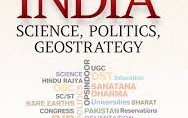
Over the last few years, I've encountered these common questions from Indian citizens about delimitation, something most of us hadn’t even heard of a few years ago. I started writing some short articles about this around a decade ago, and my latest book, “India: Science, Politics, Geostrategy” from Garuda Press, assesses them with the wisdom of hindsight. The essence of my argument is that correct delimitation can occur only if the states of India are roughly equal in size, meaning we have around 75 states, each with a population of approximately two crore.

The book Urban Naxals by film-maker Vivek Agnihotri is an eye-opener! The book is published by Garuda Prakashan and available at Garuda Books. It tells of his journey in making of the film “Buddha in a Traffic Jam” which exposed the nexus between an India-wide Maoist terror movement and their supporters in urban centers such as academia and media.